
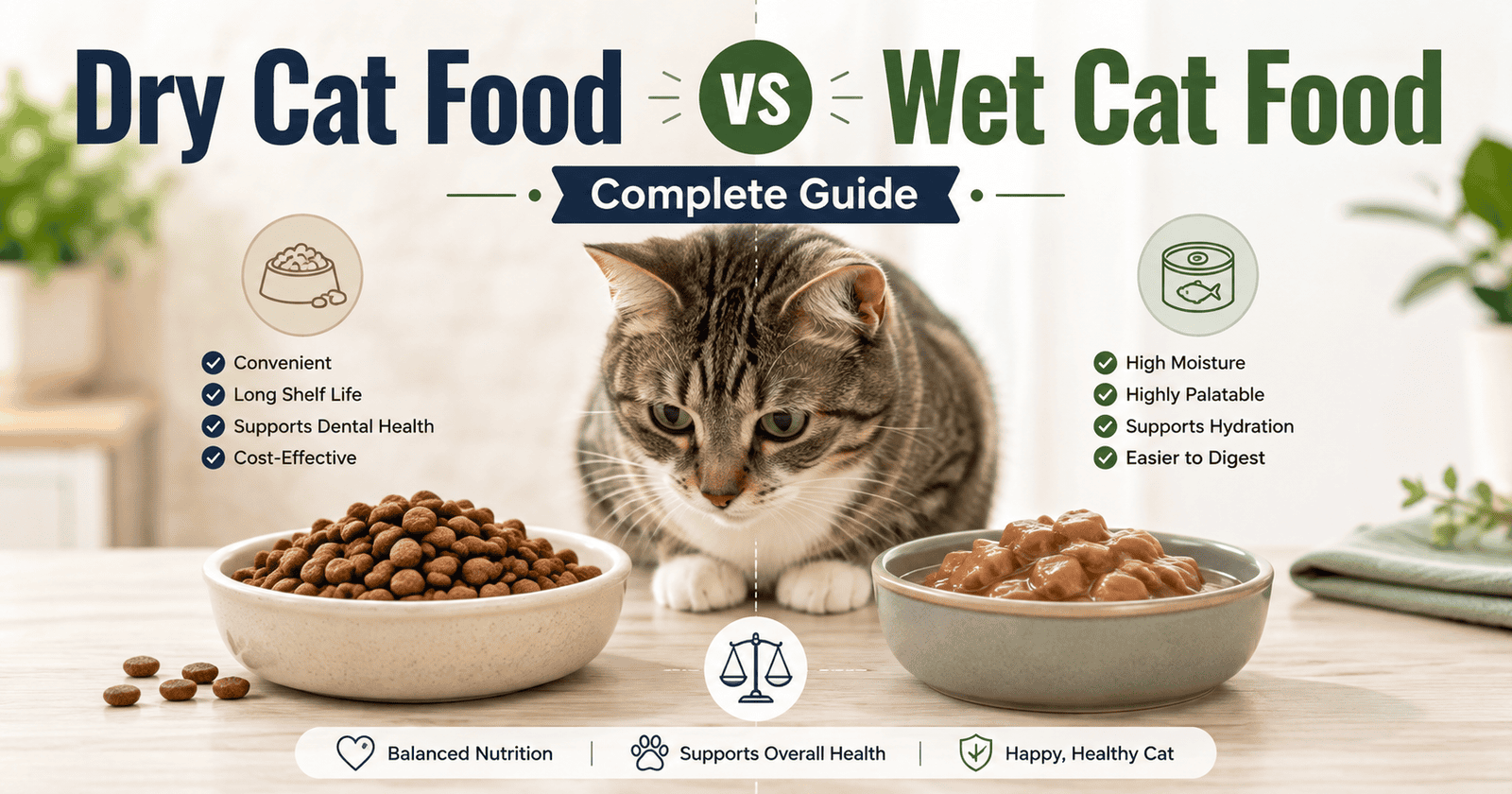
Choosing the right food is an important part of keeping your cat healthy, active, and comfortable. Two of the most common options are dry cat food and wet cat food, and both can provide balanced nutrition when you choose a suitable complete cat-food formula.
Dry food is convenient, easy to store, and economical, while wet food contains more moisture and may be more appealing to some cats. The best choice depends on your cat’s age, health, activity level, preferences, and daily nutritional needs.
This guide explains the differences between dry and wet cat food, their advantages and disadvantages, and how to decide which option may be suitable for your cat.
Understand the Difference Between Dry and Wet Cat Food
The main difference between dry and wet cat food is their moisture content and texture.
Dry cat food usually comes in the form of small pieces known as kibble. It contains relatively little moisture and can be stored conveniently after opening when kept properly.
Wet cat food contains significantly more water and is commonly available in:
Cans
Pouches
Trays
Tins
It may come in different textures, including:
Chunks in gravy
Chunks in jelly
Pâté
Minced food
Shredded meat
Both dry and wet foods can provide suitable nutrition when they are labelled as complete and balanced for your cat’s life stage.
What Is Dry Cat Food?
Dry cat food is a low-moisture food commonly sold as kibble. It is one of the most convenient options for everyday feeding.
Dry cat food is generally:
Easy to measure
Easy to store
Convenient to serve
Less messy than wet food
Suitable for automatic feeders
Available in many formulas
Usually economical per serving
Different dry-food products are available for kittens, adults, senior cats, indoor cats, sterilised cats, and cats with specific nutritional needs.
Always check the packaging to make sure the food is appropriate for your cat’s age and life stage.
Advantages of Dry Cat Food
One of the biggest advantages of dry food is convenience.
Dry food can be useful because it:
Can remain fresh in the bowl longer than wet food
Is easy to portion using a kitchen scale
Can be used with automatic feeders
Requires less refrigerator storage
Creates less feeding mess
Is convenient for multi-cat households
Can be purchased in larger bags
Dry kibble can also be useful in puzzle feeders and interactive feeding toys, which can encourage cats to eat more slowly and provide mental stimulation.
Disadvantages of Dry Cat Food
Dry food contains significantly less moisture than wet food. Cats therefore need to obtain more of their daily water intake by drinking separately.
Possible disadvantages include:
Lower moisture intake
Some cats may find it less appealing
Cats may overeat if food is available all day
Portions can easily become too large
Open bags can lose freshness if stored incorrectly
Because dry food is calorie-dense, even a relatively small amount can contain a considerable number of calories.
Accurate portion control is particularly important for indoor or less-active cats.
What Is Wet Cat Food?
Wet cat food has a soft texture and contains a much higher level of moisture than dry food.
It is commonly available as meat or fish-based recipes served in gravy, jelly, broth, or pâté-style textures.
Wet cat food is generally:
High in moisture
Soft and easy to eat
Highly palatable for many cats
Available in individual portions
Available in many flavours and textures
Wet food can be served as a cat’s main diet or combined with suitable dry food.
Advantages of Wet Cat Food
The higher moisture level is one of the main advantages of wet cat food.
Wet food can:
Increase your cat’s overall water intake
Provide a soft and easy-to-eat texture
Be appealing to selective eaters
Offer different flavours and textures
Make portion-controlled meals easier
Help cats consume more moisture through their diet
Cats naturally obtain some of their water from food, so wet food can contribute significantly to their daily fluid intake.
Fresh drinking water should still always be available.
Disadvantages of Wet Cat Food
Wet cat food also has some disadvantages compared with dry food.
It can be:
More expensive per serving
Less convenient to store after opening
Messier to serve
Less suitable for leaving out for long periods
More difficult to use in automatic feeders
More likely to spoil when left at room temperature
Opened wet food usually needs to be covered and refrigerated according to the manufacturer’s instructions.
Any food left in your cat’s bowl for an extended period should be removed.
Compare the Moisture Content
Moisture is one of the biggest differences between dry and wet cat food.
Dry food contains relatively little water, while wet food contains a much larger proportion of moisture.
Cats eating mainly dry food therefore need to drink more water independently.
Cats eating wet food receive some of their daily fluid intake directly through their meals.
Regardless of the food type, always provide:
Fresh drinking water
Clean water bowls
Multiple water locations when possible
Regularly washed bowls
Some cats may also prefer drinking from a pet water fountain.
Compare the Calorie Density
Dry cat food is generally more calorie-dense than wet food because it contains less water.
A small amount of dry kibble may therefore contain similar calories to a much larger serving of wet food.
This makes portion measurement important.
Do not assume that the same volume of dry and wet food provides the same amount of energy.
Always check:
Calories per serving
Recommended daily quantity
Your cat’s body weight
Your cat’s activity level
Feeding instructions on the package
If your cat is gaining or losing weight unexpectedly, its feeding amount may need to be reviewed.
Compare Convenience
Dry cat food is generally more convenient for storage and everyday feeding.
It can be particularly useful for:
Busy households
Automatic feeders
Puzzle feeders
Multi-cat homes
Owners buying larger food packages
Wet food requires slightly more management because opened portions may need refrigeration and uneaten food should not remain in the bowl for long periods.
However, individually portioned pouches and trays can make wet feeding convenient.
Compare Storage Requirements
Dry cat food should be kept in a cool and dry location.
For best storage:
Close the bag securely after use
Keep food away from direct sunlight
Avoid humid areas
Check the expiry date
Keep the original packaging when possible
Use a clean airtight storage container if required
Wet food has different storage requirements.
Unopened cans and pouches can generally be stored in a cool, dry cupboard.
After opening:
Cover unused food
Refrigerate it promptly
Follow the manufacturer’s storage instructions
Discard food that looks or smells unusual
Good storage helps maintain food quality and reduces contamination.
Compare Cost
Dry cat food is often more economical per meal, especially when purchased in larger bags.
Wet food may cost more because it contains more water and usually comes in smaller cans, trays, or pouches.
Your total feeding cost depends on:
Your cat’s size
Daily calorie requirements
Food brand
Package size
Food quality
Whether you use mixed feeding
Price should not be the only factor when choosing your cat’s diet. The food should provide suitable nutrition for its age and lifestyle.
Which Food Is Better for Hydration?
Wet food provides considerably more moisture through your cat’s diet.
This can be helpful for cats that naturally drink relatively little water.
However, feeding wet food does not mean drinking water is unnecessary.
Your cat should always have unrestricted access to clean, fresh water.
To encourage drinking, you can:
Place multiple water bowls around the home
Keep water away from dirty litter areas
Wash bowls regularly
Replace water daily
Try different bowl materials
Consider using a cat water fountain
Monitor any major changes in your cat’s drinking behaviour.
Is Dry Food Good for Cats?
Dry cat food can be a suitable everyday diet when it is nutritionally complete, balanced, appropriate for your cat’s life stage, and fed in the correct quantity.
When choosing dry food, check:
Life-stage suitability
Protein sources
Feeding recommendations
Calorie information
Ingredient information
Storage instructions
The correct portion will vary between products because different formulas contain different calorie densities.
Is Wet Food Good for Cats?
Wet cat food can also provide complete nutrition when you choose a formula designed as a complete diet.
Wet food can be especially useful for cats that:
Prefer softer food
Do not drink much water
Enjoy different textures
Have difficulty chewing hard kibble
Prefer stronger food aromas
However, individual health conditions may affect which diet is suitable.
Consult your veterinarian when your cat has ongoing health concerns or requires a specialised diet.
Can You Feed Your Cat Both Dry and Wet Food?
Yes, many cats can be fed a combination of dry and wet food.
This is commonly called mixed feeding.
For example, a cat might receive:
Wet food in the morning
A measured portion of dry food later
Wet food again in the evening
The exact schedule can be adjusted according to your cat’s routine.
Mixed feeding allows owners to combine the convenience of dry kibble with the additional moisture provided by wet food.
Avoid Overfeeding When Mixing Dry and Wet Food
One common mistake is providing the full recommended quantity of both dry food and wet food.
Doing this can significantly increase your cat’s total calorie intake.
Instead, calculate the combined daily amount.
For example, if wet food provides part of your cat’s daily calories, reduce the amount of dry food accordingly.
Check the feeding recommendations provided by both manufacturers and monitor your cat’s body condition.
Measure Dry Cat Food Accurately
Dry food can easily be overfed because a small amount contains a relatively high number of calories.
Using a kitchen scale is usually more accurate than estimating portions by eye.
Accurate measurement helps:
Control calorie intake
Maintain a healthy weight
Keep meal sizes consistent
Identify changes in appetite
Prevent accidental overfeeding
Measure your cat’s complete daily amount before dividing it into individual meals.
Measure Wet Food Portions
Wet-food portions should also be controlled.
Some pouches or cans are designed as individual servings, while larger containers may need to be divided between several meals.
Check the packaging for:
Recommended feeding quantity
Cat weight range
Number of pouches or cans per day
Calorie information
Life-stage information
Remember that recommendations are starting points. Individual cats can have different energy requirements.
Consider Your Cat’s Age
A cat’s nutritional requirements change throughout its life.
Cats can generally be divided into:
Kittens
Adult cats
Senior cats
Pregnant or nursing cats
Kittens require food designed to support growth and development.
Adult cats need balanced nutrition to maintain body weight and general health.
Senior cats may have different nutritional requirements depending on their activity level and health.
Always choose food appropriate for your cat’s life stage.
Consider Your Cat’s Activity Level
An active cat may require more calories than a cat that spends most of its time indoors with limited activity.
Cats that may require more energy include:
Highly active cats
Outdoor cats
Young adult cats
Pregnant or nursing cats
Cats that may require fewer calories include:
Indoor cats
Older cats
Sterilised cats with lower energy requirements
Cats with limited activity
Cats prone to gaining weight
Adjust food quantities gradually and monitor body condition.
Consider Your Cat’s Body Weight
Body weight is an important factor when determining daily food quantity.
However, the number on the scale should not be considered alone.
Monitor:
Body weight
Waist shape
Rib coverage
Muscle condition
Activity level
Eating behaviour
If your cat is significantly overweight or underweight, consult a veterinarian rather than making major dietary changes without guidance.
Watch Your Cat’s Body Condition
Regularly checking your cat’s body condition can help determine whether its food quantity is appropriate.
A cat at a healthy body condition generally has:
Ribs that can be felt under a light layer of fat
A visible waist when viewed from above
A balanced body shape
Good muscle condition
Stable body weight
Weight should be monitored regularly, especially when changing food or feeding quantities.
Which Food Is Better for Kittens?
Kittens require food specifically formulated for growth.
Both dry and wet kitten foods can be suitable if they provide complete and balanced nutrition for kittens.
Some owners use a combination of both.
Wet kitten food provides moisture and a soft texture, while dry kitten kibble can provide convenience.
Make sure the food is labelled specifically for kittens or growth rather than relying on standard adult cat food.
Which Food Is Better for Senior Cats?
Senior cats may benefit from different food depending on their health, appetite, dental condition, activity level, and individual preferences.
Wet food’s soft texture may be easier for some older cats to eat.
However, many senior cats continue to eat dry food comfortably.
When feeding an older cat:
Monitor body weight
Monitor appetite
Provide fresh water
Choose age-appropriate food
Watch for difficulty chewing
Notice changes in drinking habits
Regular veterinary health checks become increasingly important as cats age.
Consider Your Cat’s Food Preferences
Cats can be selective eaters.
Some prefer:
Crunchy kibble
Soft pâté
Chunks in gravy
Chunks in jelly
Fish flavours
Chicken or meat flavours
Finding a texture and flavour your cat enjoys can make feeding easier.
However, avoid frequently changing food simply because your cat temporarily refuses one meal.
Sudden changes can also upset digestion.
Change Cat Food Gradually
When switching from one cat food to another, introduce the new food gradually.
A simple transition can be:
Days one and two: 75% old food and 25% new food
Days three and four: 50% old food and 50% new food
Days five and six: 25% old food and 75% new food
Day seven onward: 100% new food
Some cats may need a slower transition.
Monitor appetite, stool quality, vomiting, and general behaviour throughout the change.
Do Not Leave Wet Food Out Too Long
Wet food can spoil more quickly than dry food, particularly in warm environments.
Serve a suitable portion and remove uneaten food rather than allowing it to remain in the bowl for extended periods.
During hot weather, wet food may spoil faster.
Always:
Use clean feeding bowls
Wash bowls after meals
Refrigerate opened food
Follow package storage instructions
Discard spoiled or contaminated food
Good hygiene helps keep your cat’s feeding area safe.
Avoid Free-Feeding Large Amounts of Dry Food
Leaving unlimited dry food available all day can make it difficult to monitor how much your cat eats.
This is particularly important in multi-cat households.
Controlled meals make it easier to:
Monitor appetite
Control portions
Manage body weight
Notice changes in eating habits
Identify which cat is eating
If you use an automatic feeder, measure the complete daily food quantity before filling it.
Provide Fresh Water Every Day
Regardless of whether your cat eats dry food, wet food, or both, fresh water should always be available.
Remember to:
Replace drinking water daily
Wash bowls regularly
Provide more than one water source
Keep water bowls clean
Monitor your cat’s drinking behaviour
Some cats prefer wide bowls that prevent their whiskers from touching the sides.
Others may prefer running water from a pet fountain.
Watch for Changes in Appetite
A sudden change in appetite can sometimes indicate a health problem.
Watch for:
Refusing meals
Eating significantly less
Eating significantly more
Difficulty chewing
Dropping food while eating
Vomiting frequently
Unexpected weight loss
Unexpected weight gain
If these changes continue, consult a veterinarian.
When Should You Ask a Veterinarian?
Professional advice is particularly important when your cat:
Stops eating
Loses weight unexpectedly
Gains excessive weight
Vomits frequently
Has ongoing diarrhoea
Has difficulty chewing
Drinks significantly more or less water
Has a diagnosed medical condition
Has food allergies or intolerances
Requires a prescription diet
Is pregnant or nursing
Is a very young kitten
Cats with specific medical conditions may require specialised diets that should be selected with veterinary guidance.
Dry Cat Food vs Wet Cat Food: Which Should You Choose?
There is no single answer that is suitable for every cat.
Dry food may be a good choice if you want:
Convenient storage
Easy portioning
Automatic feeder compatibility
A more economical feeding option
Food suitable for puzzle feeders
Wet food may be a good choice if you want:
Higher moisture intake
Soft food texture
Strong food aroma
Individual portions
More flavour and texture variety
Mixed feeding can provide some of the advantages of both options.
The most important factor is choosing nutritionally complete food appropriate for your cat’s age, body condition, health, and lifestyle.
Final Thoughts
Both dry cat food and wet cat food can form part of a healthy diet when they provide complete and balanced nutrition and are served in appropriate quantities.
Dry food offers convenience, easy storage, and economical feeding, while wet food provides additional moisture and a soft, appealing texture. Some cats may do well with one type, while others may benefit from a combination of both.
Whichever option you choose, measure portions carefully, provide fresh drinking water every day, monitor your cat’s body weight and condition, and make dietary changes gradually.
Your cat’s nutritional requirements can change with age, activity level, weight, and health. If you are unsure which food or feeding routine is suitable, speak with your veterinarian for personalised advice.


 No products in the cart.